Partial Differential Equations
Analysis, qualitative behavior, and applications of PDE models.
03 - 04 November 2026
A national meeting for researchers, academics, doctoral students, and professionals to exchange ideas and advance mathematical modelling, analysis, and computation.


Organized by
Faculty of Exact Sciences and Natural and Life Sciences · Laboratory of Mathematics, Informatics and Systems (LAMIS)
Conference begins in
CAMNA'26 welcomes contributions across core areas.
Analysis, qualitative behavior, and applications of PDE models.
ODE theory, systems, stability, and application-driven models.
Nonlinear dynamics, long-term behavior, control, and bifurcation.
Models for complex phenomena in science, society, and technology.
Computational methods, approximation, simulation, and validation.
This plenary lecture presents recent advances in spectral approximation and numerical analysis of nonlinear eigenvalue problems. It focuses on quadratic operator pencils and Schrödinger operators, with emphasis on projection methods and generalized ν-convergence. The presentation discusses approaches to reduce spectral pollution and ensure reliable approximation of eigenvalues. Integral methods for nonlinear Volterra equations with singular kernels are also considered.
This talk introduces the theory of partial differential equations involving fractional operators. It presents the main concepts of fractional calculus and their role in modern mathematical modeling. The lecture discusses fractional differential equations, analytical techniques, and numerical approaches. Applications to complex phenomena governed by nonlocal behavior will also be highlighted.
This presentation studies the existence, uniqueness, and stability properties of multidimensional Schrödinger equations. The analysis is developed under general boundary dissipations of diffusive type. Semigroup theory is used to establish well-posedness results. Frequency-domain techniques are applied to investigate long-term behavior and stability.
This lecture presents the role of mathematical modeling in experimental sciences. It discusses the construction, analysis, and simulation of mathematical models. Applications in medicine and pharmacology are explored through mathematical frameworks. The talk highlights how modeling contributes to understanding complex systems and interactions.
This talk focuses on the Lewy–Stampacchia inequality and its importance in nonlinear analysis. The method provides powerful tools for studying variational inequalities. Existence and regularity results are established for nonlinear constrained problems. The presentation highlights theoretical developments and mathematical applications.
The final timetable, rooms, and session assignments will be announced after acceptance notifications.
| Participant type | Registration Fee |
|---|---|
| PhD Students | 3000 DA |
| Academics / Researchers | 4500 DA |
Known in antiquity as Theveste, Tébessa offers a remarkable archaeological landscape where Roman and Byzantine heritage meets the life of a modern Algerian city.
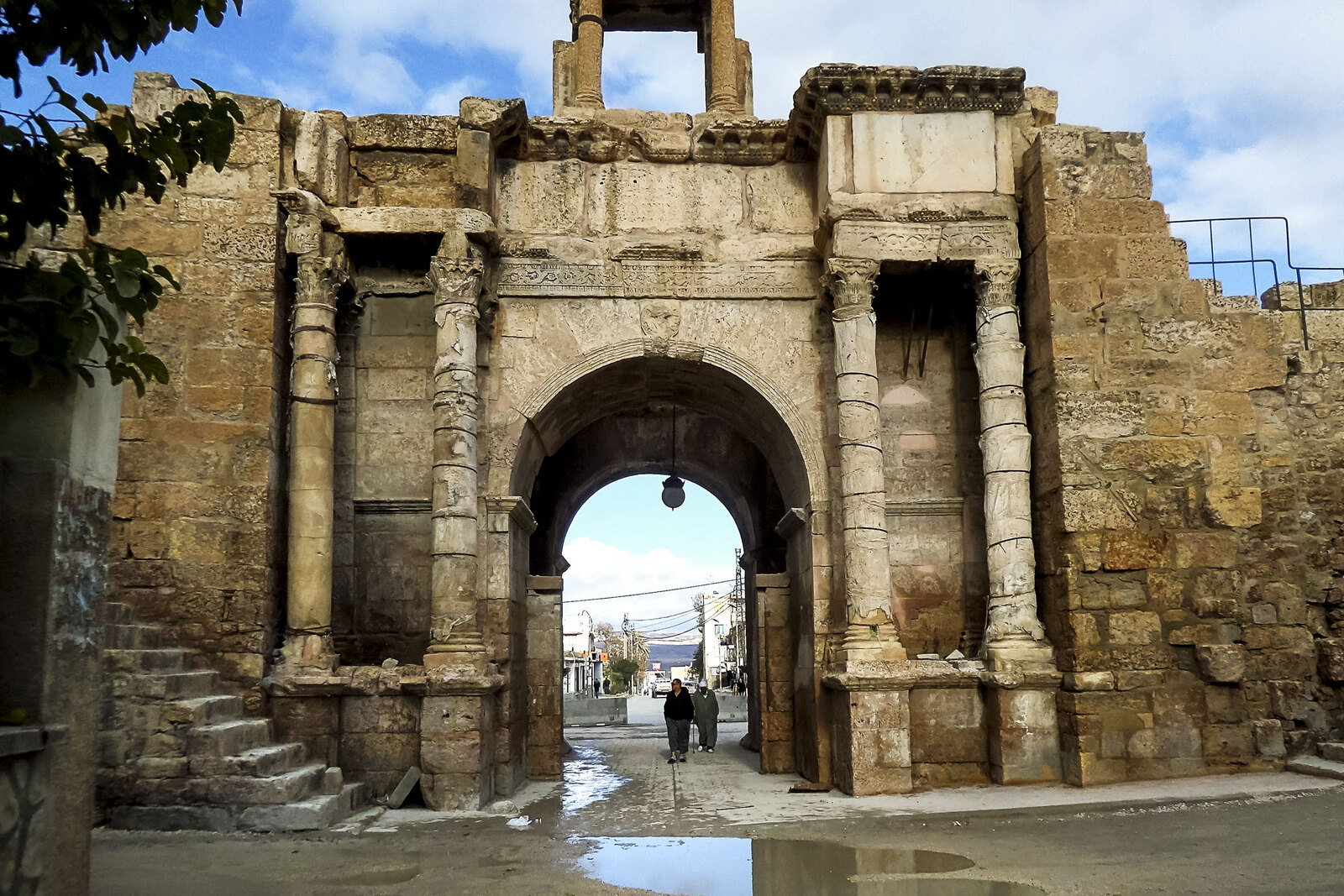 Roman heritage
A monumental early third-century tetrapylon and one of the city's most recognizable gateways, standing beside the historic fortifications.
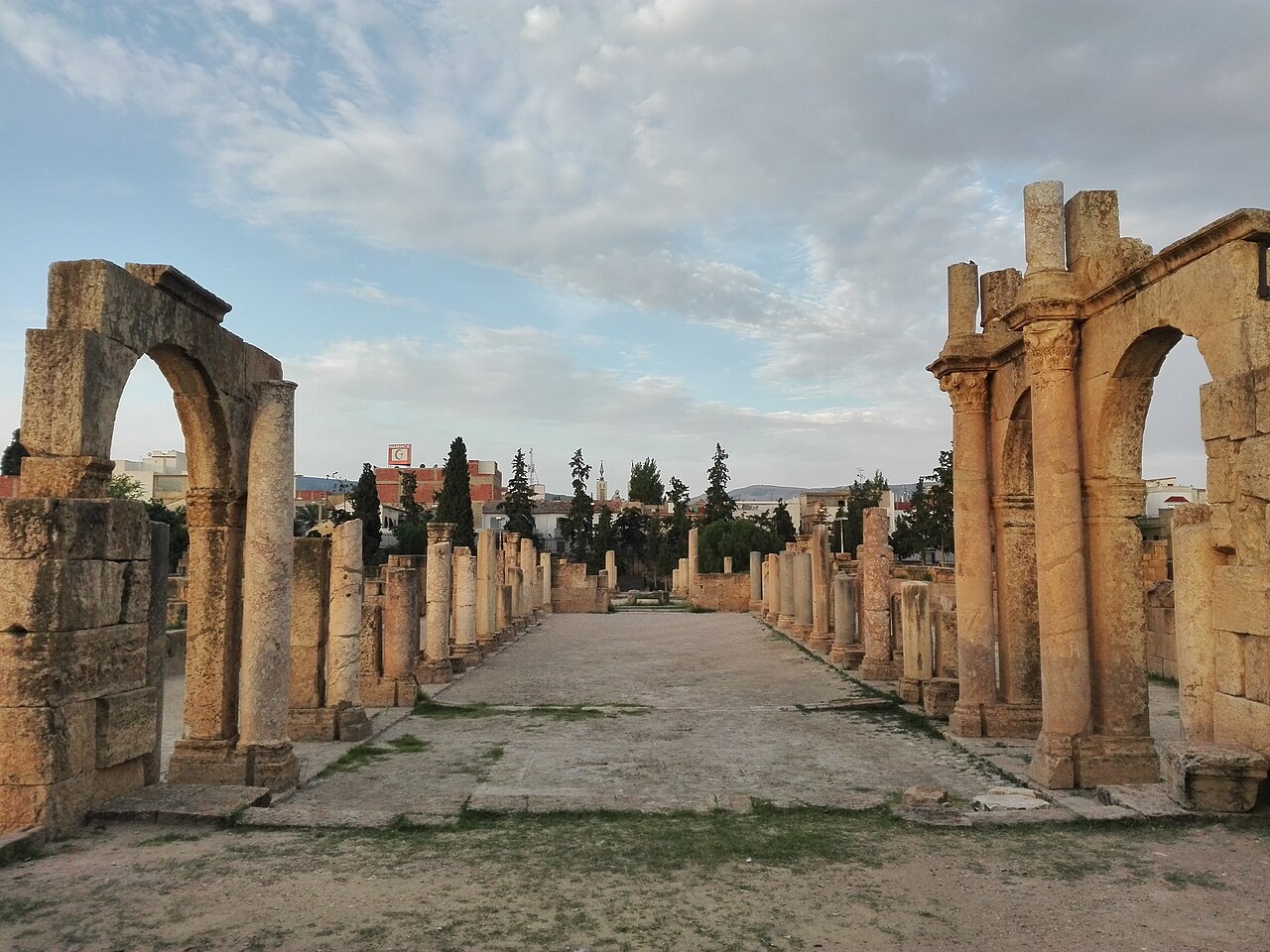 Late antiquity
Explore the remains of an extensive early Christian complex, with colonnaded spaces and stone architecture that evoke ancient Theveste.
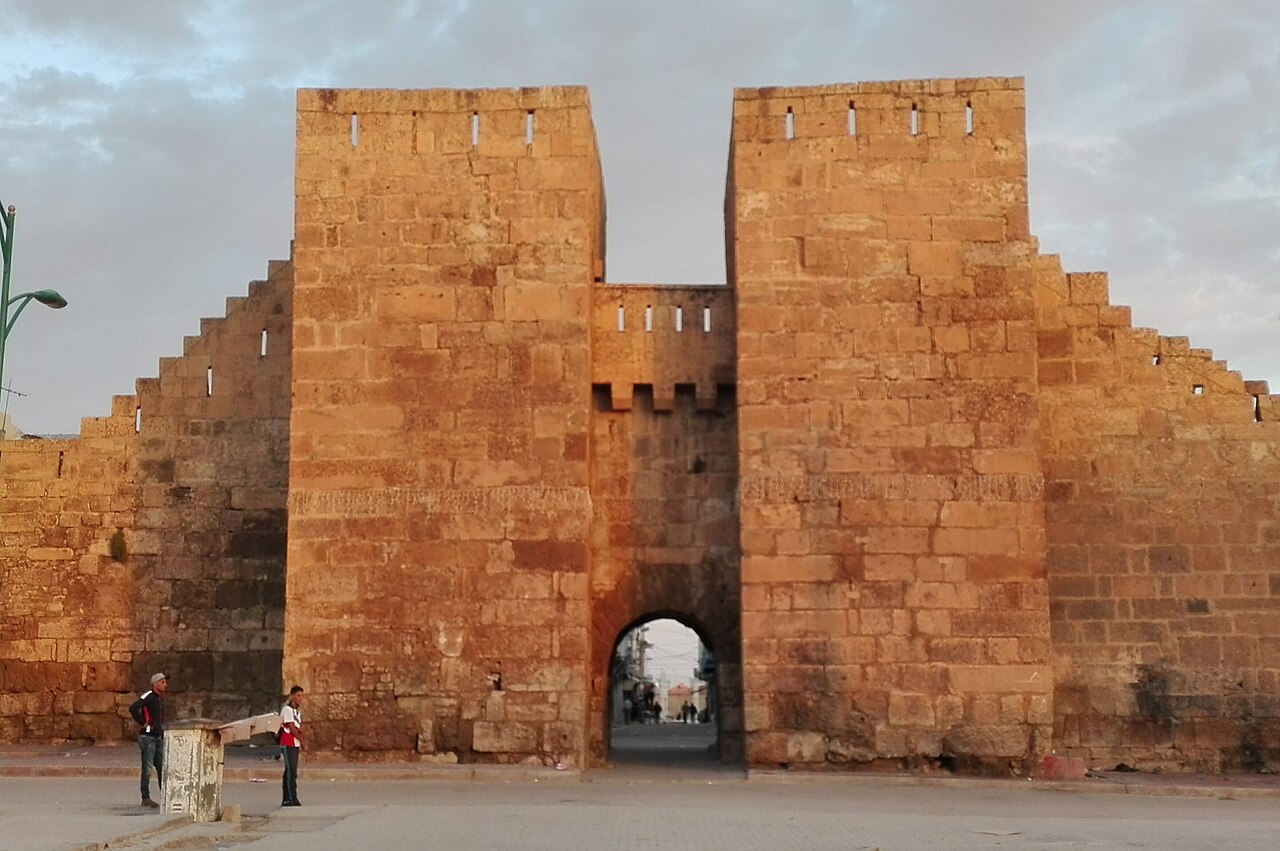 Byzantine heritage
Massive walls, towers, and historic gates frame the old city and reveal the strategic importance of Tébessa through the centuries.
The wider archaeological ensemble also includes the Temple of Minerva and other protected monuments. Tébessa's archaeological heritage was added to Algeria's UNESCO World Heritage Tentative List in 2025.